Adolescent Idiopathic Scoliosis (AIS) presents a complex challenge for rehabilitation professionals, primarily due to the intricate neuromuscular imbalances that accompany the structural deformity. While the Cobb angle remains the gold standard for monitoring progression, understanding the underlying paraspinal muscle activity—specifically the asymmetry between the concave and convex sides—is crucial for effective conservative management. A recent Randomized Controlled Trial (RCT) published in the China Journal of Orthopaedics and Traumatology offers compelling evidence regarding the efficacy of segmental spinal manipulation (SSM) compared to standard massage therapy.
Neuromuscular Imbalance in AIS
In patients with AIS, paraspinal muscles exhibit distinct asymmetries. Typically, muscles on the convex side are elongated and often subjected to eccentric loading, while those on the concave side are shortened and tighter. This RCT, conducted between 2022 and 2023 involving 90 adolescents, sought to evaluate how specific manual therapy interventions influence these electromyography (EMG) parameters. The researchers utilized two specific metrics: Turns (reflecting motor unit recruitment and firing frequency) and Mean Amplitude (MA, reflecting muscle force).
Study Methodology and Intervention
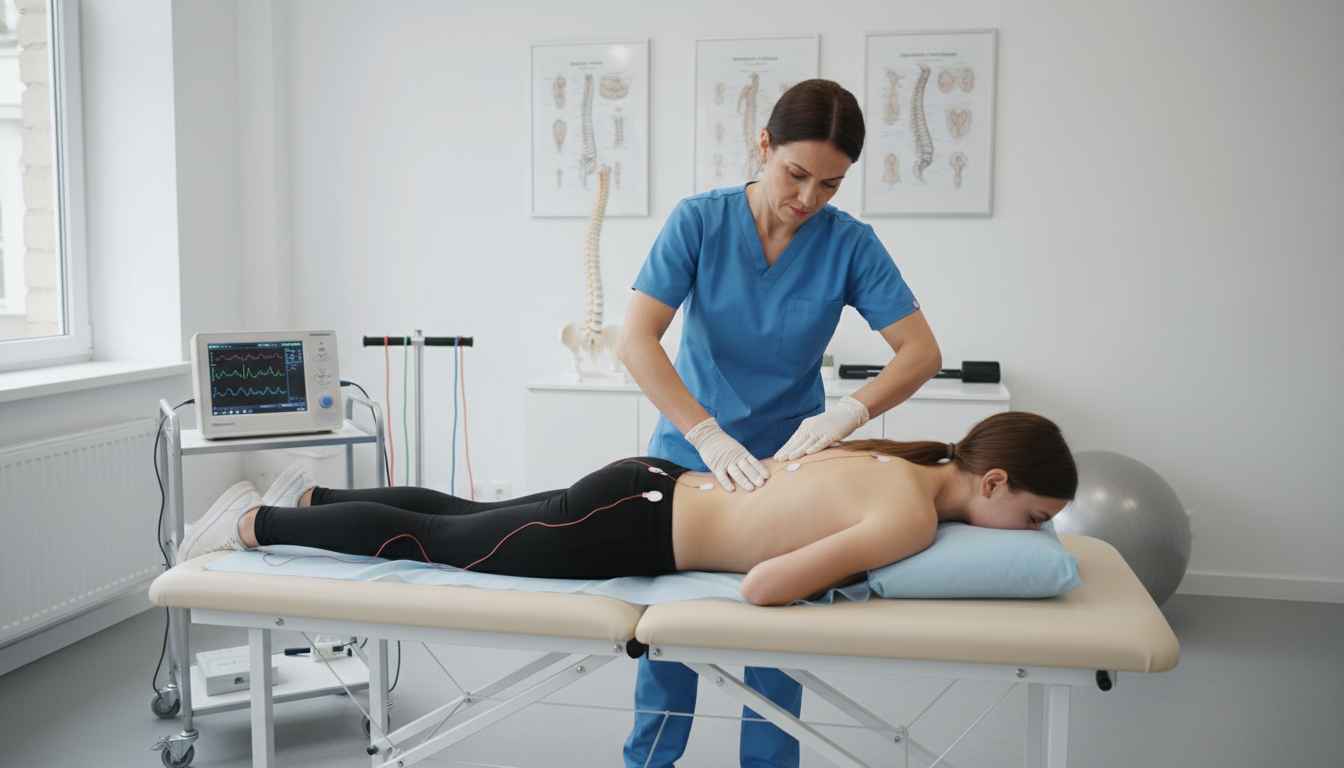
The study randomized 90 participants aged 10 to 18 into two groups. The control group (n=45) received ordinary massage therapy, while the observation group (n=45) underwent segmental spinal manipulation. Both groups were treated once a week for 12 weeks. By measuring needle electromyogram parameters in various positions—including standing, hyperextension, flexion, and rotation—the authors provided a granular look at dynamic muscle function before and after the 12-week regimen.
Key Findings: EMG Turns and Structural Correction
The results highlighted a significant advantage for the manipulation group regarding the redistribution of muscle activity. Post-treatment data revealed that SSM effectively increased EMG Turns on the convex side while decreasing Turns on the concave side across multiple functional positions. This suggests that segmental manipulation facilitates a normalization of motor unit firing—upregulating the inhibited musculature on the convexity and downregulating the hyperactive musculature on the concavity.
Comparatively, while both groups saw improvements in Mean Amplitude (general muscle strength), the manipulation group demonstrated superior outcomes in specific postural contexts. More importantly, the structural outcome was distinct: the observation group showed a statistically significant reduction in the Cobb angle compared to the massage group.
Clinical Implications for Physiotherapists
The authors concluded that while SSM improves strength (MA), its unique value lies in adjusting the “Turns” index. This implies that manipulation acts as a form of neuromuscular re-education, altering muscle fiber recruitment types to balance the spinal forces. For clinicians, this reinforces the utility of high-velocity, low-amplitude (HVLA) or specific segmental mobilization techniques not just for joint mobility, but for modulating paraspinal tone and reducing scoliotic curvature via three-dimensional adjustment.
References
Tian, J., Wu, J., Xie, H., Ying, X., Ye, X., & Yao, R. (2026). Effects of segmental spinal manipulation on adolescent scoliosis based on electromyography parameters. Zhongguo gu shang = China Journal of Orthopaedics and Traumatology, 39(1). https://pubmed.ncbi.nlm.nih.gov/41663256/