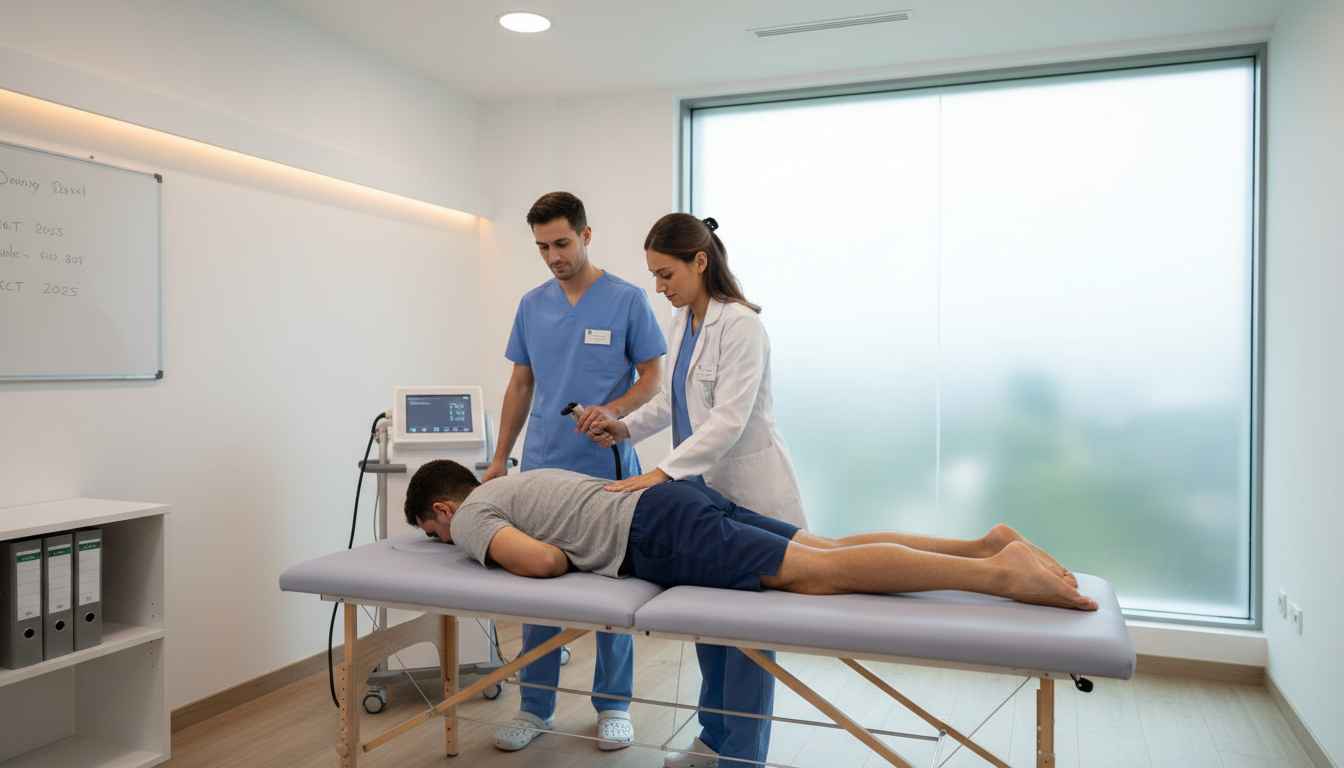
Plantar fasciitis (PF) remains one of the most persistent and prevalent conditions encountered in orthopaedic rehabilitation. While conservative management is the standard of care, the debate regarding the most efficacious modality continues to evolve. Specifically, the long-term utility of radial Extracorporeal Shock Wave Therapy (rESWT) compared to traditional physiotherapy combined with ultrasound has generated conflicting evidence. A recent randomized controlled trial (RCT), published in BMC Musculoskeletal Disorders in October 2025, offers new clarity on this subject, providing valuable data for clinicians managing recalcitrant heel pain.
Study Design and Methodology
Conducted within a Tunisian tertiary care rehabilitation department, this study aimed to evaluate the comparative effectiveness of rESWT against a control group receiving physiotherapy combined with ultrasound. The researchers recruited 129 patients diagnosed with PF, ensuring a robust sample size for statistical analysis. The cohort was randomly allocated into two arms: 66 participants received rESWT, while 63 underwent a standard regimen of physiotherapy and ultrasound.
The demographics of the study reflected the typical patient profile seen in clinical practice. The average age was approximately 50 years, with a significant female predominance (78%) and an average Body Mass Index (BMI) of 29.2 kg/m², highlighting the correlation between weight-bearing load and fascial pathology. Uniquely, this trial also incorporated baropodometry to screen for foot disorders, a critical component often overlooked in modality-focused studies.
Comparative Outcomes: rESWT vs. Ultrasound
The primary outcome measure was the Visual Analogue Scale (VAS) for pain, specifically monitoring morning pain, which is the hallmark symptom of PF. The results indicated that both protocols were highly effective. Both the rESWT group and the physiotherapy/ultrasound group demonstrated a statistically significant decrease in VAS scores across all follow-up periods (short-term and mid-term).
Interestingly, the study found no significant difference in mean VAS scores between the two groups at any post-treatment interval. For the clinician, this suggests that rESWT is non-inferior to standard physiotherapy combined with ultrasound. It provides a viable alternative for clinics that may wish to optimize treatment times or offer options for patients who have plateaued with traditional manual therapy and ultrasound.
The Role of Biomechanics and Foot Architecture
Perhaps the most clinically relevant secondary finding of this RCT was the high prevalence of structural foot disorders within the PF population. Through baropodometric screening, the authors identified that 45% of participants presented with pes cavus (high arches), while 36% presented with pes planus (flat feet).
This data reinforces the necessity of a comprehensive biomechanical evaluation. While modalities like rESWT or ultrasound effective at modulating pain and stimulating tissue healing, they do not address the underlying structural drivers. The high incidence of pes cavus and pes planus suggests that long-term management must include orthotic intervention, footwear modification, or specific strengthening protocols to address the foot architecture.
Clinical Implications
The findings of this 2025 trial support the use of rESWT as a first-line intervention for plantar fasciitis, comparable in efficacy to standard physiotherapy with ultrasound. However, the authors rightly conclude that successful management extends beyond the modality choice. Clinicians must screen for foot disorders initially. Whether treating with shockwave or ultrasound, addressing the structural anomalies—specifically pes cavus and pes planus—remains a cornerstone of preventing recurrence and ensuring long-term recovery.
References
Ines, L., Rihab, M., Sana, B., Saoussen, L., Mariem, G., Sinene, F., & Sonia, J. (2025). The effectiveness of radial extracorporeal shock wave therapy (rESWT) in plantar fasciitis: a 12 months randomised controlled trial in a Tunisian rehabilitation department. BMC Musculoskeletal Disorders. https://pubmed.ncbi.nlm.nih.gov/41063112/