The Challenge of BoNT-A Injections in Chronic Migraine Management
For patients suffering from chronic migraines, onabotulinumtoxinA (BoNT-A) injections have proven to be a highly effective preventive treatment. However, the procedure is far from comfortable. A single session typically requires 31 to 40 individual injections around the head and neck. For many patients, this leads to significant procedural discomfort and a high incidence of post-procedural headaches, which can deter adherence to this essential therapy. As rehabilitation and pain management professionals, finding non-invasive methods to mitigate acute procedural pain is a continuous clinical pursuit.
Conditioned Pain Modulation Through Remote Electrical Neuromodulation (REN)
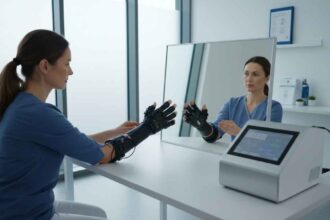
A fascinating recent study published in Headache (Feb 2026) explored the use of remote electrical neuromodulation (REN) to address this exact clinical hurdle. REN is an innovative, non-invasive wearable technology that delivers mild electrical stimulation. By stimulating peripheral nerves in the upper arm, REN leverages the body’s natural conditioned pain modulation (CPM) pathways to induce a systemic analgesic effect.
In this rigorously designed single-center, randomized, sham-controlled crossover study, researchers enrolled 80 adults with chronic migraine. Each patient underwent their standard BoNT-A injection session without any device, followed by sessions utilizing either active REN or a sham device in a randomized order. The device was applied to the upper arm just 10 minutes prior to the injection procedure and remained active until the injections were completed.
Unprecedented Efficacy Prompting Early Trial Termination
The results of the trial were so overwhelmingly positive that the study was terminated early based on predefined stopping criteria. Final analysis of the 60 participants revealed profound clinical benefits. While pre-procedural pain levels were consistent across all groups, patients utilizing the active REN device experienced significantly lower pain scores during and after the BoNT-A administration.
Specifically, the active REN group demonstrated a mean intra-procedural pain reduction of 15.0 points on the visual analog scale (VAS), and a remarkable 19.1-point reduction post-procedure. In stark contrast, the sham treatment offered no significant pain relief compared to baseline. Furthermore, REN drastically reduced the incidence of post-procedural headaches—dropping from 55% in the sham group to a mere 15% in the active REN group.
Relevance for Physiotherapists and Pain Specialists
For physiotherapists and allied health professionals, these findings underscore the immense potential of peripheral neuromodulation in acute pain management. While physiotherapists frequently utilize modalities like TENS to manage musculoskeletal pain, the application of REN to specifically buffer procedural pain via conditioned pain modulation expands our understanding of neurophysiology in clinical practice.
Integrating simple, non-invasive neuromodulation strategies could radically improve patient comfort, compliance, and overall treatment outcomes. As technology advances, understanding and leveraging these mechanisms will remain a cornerstone of evidence-based pain management.
References
Cheng, N., Anderson, C. C., Zhang, N., VanderPluym, J. H., & Starling, A. J. (2026). Remote electrical neuromodulation for reducing procedural pain in patients with chronic migraine receiving onabotulinumtoxinA injections: A randomized sham-controlled study. Headache.