Urinary incontinence (UI) remains one of the most prevalent conditions affecting quality of life in adult women, encompassing stress, urge, and mixed subtypes. For physiotherapists specializing in pelvic health, the gold standard for conservative management has long been Pelvic Floor Muscle Training (PFMT). However, technological advancements have introduced passive modalities, such as Extracorporeal Magnetic Innervation (ExMI), offering alternatives for patients who may struggle with volitional contraction or adherence to active exercise protocols. A recent Randomized Controlled Trial (RCT) published in the Journal of Wound, Ostomy, and Continence Nursing provides a head-to-head comparison of these two distinct interventions.
Methodological Parameters: Active Exercise vs. Magnetic Stimulation
The study, conducted by Yılmaz et al., aimed to evaluate the comparative efficacy of PFMT and ExMI regarding incontinence severity, pelvic floor muscle strength, and incontinence-specific quality of life. The research team recruited 35 adult women (mean age 46.77 ± 8.88 years) presenting with stress, urge, or mixed urinary incontinence at a urogynecology clinic. The participants were randomized into two intervention arms:
- The PFMT Group (n=19): Participants engaged in a structured pelvic floor muscle training regimen for a duration of 12 weeks.
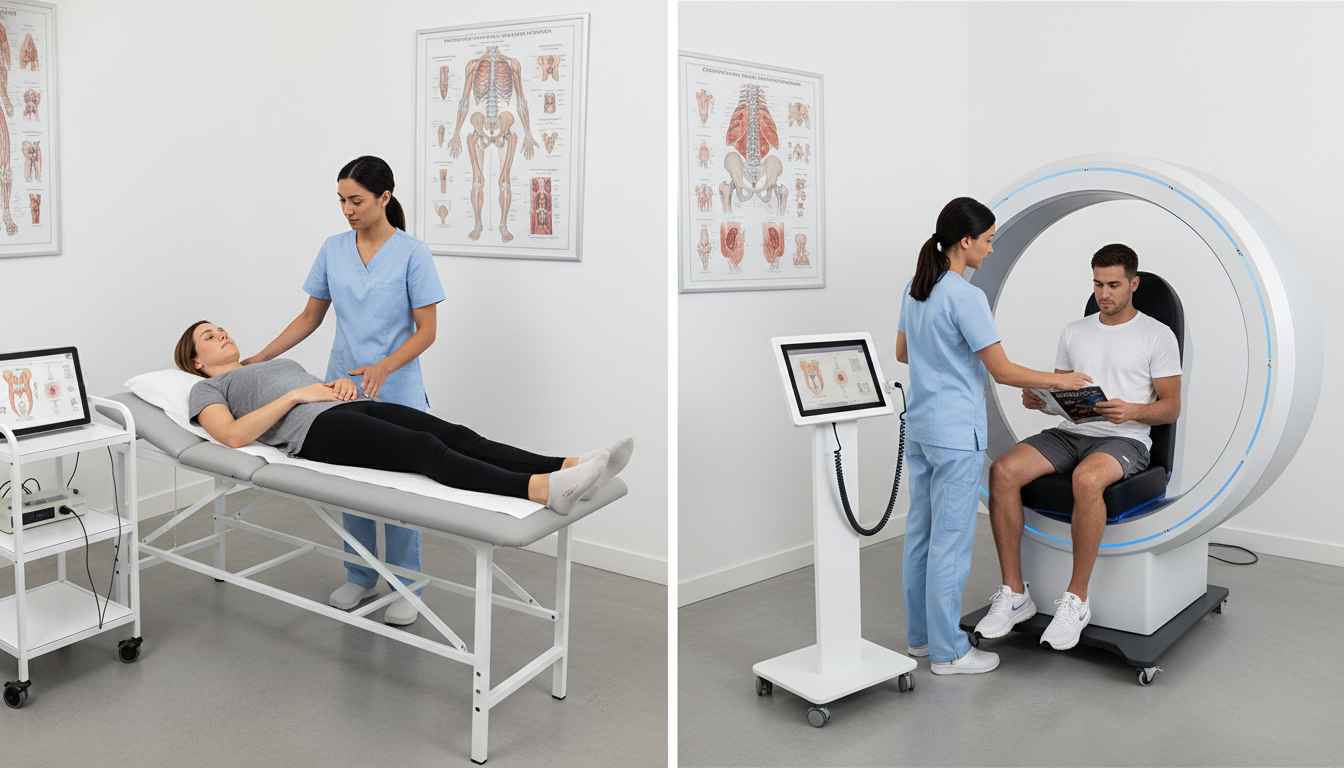
- The ExMI Group (n=16): Participants underwent Extracorporeal Magnetic Innervation. This modality utilizes a magnetic field to induce depolarization of the sacral nerve roots, causing passive contraction of the pelvic floor muscles. The protocol consisted of 20-minute sessions administered three times a week for a total of 6 weeks.
Outcomes were assessed at baseline, 6 weeks, and 12 weeks post-initiation. The researchers utilized the Mann-Whitney U test for between-group comparisons and Two-way repeated measure ANOVA to track changes over time.
Efficacy Outcomes: Strength, Severity, and Quality of Life
The results of this RCT offer significant clinical insight for rehabilitation professionals. Statistical analysis revealed that both intervention groups demonstrated significant improvements across all primary outcome measures. Specifically, patients in both the PFMT and ExMI groups reported:
- Reduced severity of incontinence symptoms.
- Measurable increases in pelvic floor muscle strength.
- Significant enhancement in incontinence-specific quality of life.
Crucially, the head-to-head comparison yielded no statistically significant differences between the two groups. This suggests that ExMI is non-inferior to traditional PFMT regarding these specific outcomes within the measured timeframe.
Clinical Implications for Pelvic Health Rehabilitation
For the practicing physiotherapist, these findings validate the utility of both active and passive approaches. While PFMT remains the cost-effective first-line treatment that promotes neuromuscular re-education and patient autonomy, ExMI presents a viable alternative for specific patient populations. This is particularly relevant for patients with extremely weak pelvic floors (0/5 or 1/5 on the Oxford scale) who cannot initiate a contraction, or for those where compliance with home exercise programs is a barrier to recovery.
Ultimately, the choice between manual training and magnetic innervation may come down to clinical logistics, equipment availability, and patient preference, as both modalities appear effective in restoring function and improving quality of life.
References
Yılmaz, S., Khorshtd, L., Aydoğmuş, S., & Bolel, Ö. (n.d.). Comparison of Pelvic Floor Muscle Training and Extracorporeal Magnetic Innervation on Urinary Incontinence, Pelvic Floor Muscle Strength, and Quality of Life in Women With Urinary Incontinence: A Randomized Controlled Trial. Journal of Wound, Ostomy, and Continence Nursing.