For pediatric physiotherapists treating children with spastic cerebral palsy (CP), balance deficits are a primary concern. These deficits are often compounded by impaired proprioception—specifically ankle joint position sense—which directly impacts gait and functional independence. While balance training on unstable surfaces is a cornerstone of neurorehabilitation, new research suggests that the texture of the surface may be just as critical as its stability. A recent randomized controlled trial published in BMC Pediatrics investigates how rough versus smooth unstable surfaces influence ankle proprioception and dynamic balance.
The Proprioceptive Deficit in Cerebral Palsy
Children with spastic hemiplegic and diplegic CP often struggle with somatosensory processing. While traditional balance training improves motor output, it does not always address the sensory input deficits that underlie motor control issues. The study by Bezgin et al. (2026) addresses a gap in the literature: does adding tactile stimulation (roughness) to vestibular/proprioceptive challenges (instability) yield better outcomes?
Study Methodology: Rough vs. Smooth Surfaces
The single-blind randomized controlled trial involved 16 children, aged 5 to 10 years, classified under the Gross Motor Function Classification System (GMFCS) at Levels I and II. The participants were randomized into two intervention groups:
- Smooth Surface Group: Performed balance exercises on a standard smooth balance board.
- Rough Surface Group: Performed the same exercises on a balance board with a rough, textured surface.
The intervention protocol consisted of 10 minutes of specific balance exercises (six movements) performed twice weekly for eight weeks, following a standard 45-minute physical therapy session. Outcome measures included the Pediatric Balance Scale, Functional Reach Test, and Single Leg Stance Test for balance, alongside a digital goniometer assessment for ankle joint proprioception (specifically at 15° dorsiflexion and plantar flexion).
Outcomes: Texture Enhances Sensory Feedback
The results provided a nuanced insight into rehabilitation mechanics. Both groups demonstrated significant improvements in functional balance scores (Pediatric Balance Scale, Functional Reach, and Single Leg Stance). This confirms that balance training on unstable surfaces—regardless of texture—is effective for gross motor improvement.
However, the critical differentiator was proprioception. Significant improvements in joint position sense (both dorsiflexion and plantar flexion on dominant and non-dominant sides) were observed only in the group training on rough surfaces (p < 0.05). The smooth surface group did not show statistically significant gains in proprioceptive acuity.
Clinical Implications for Rehabilitation
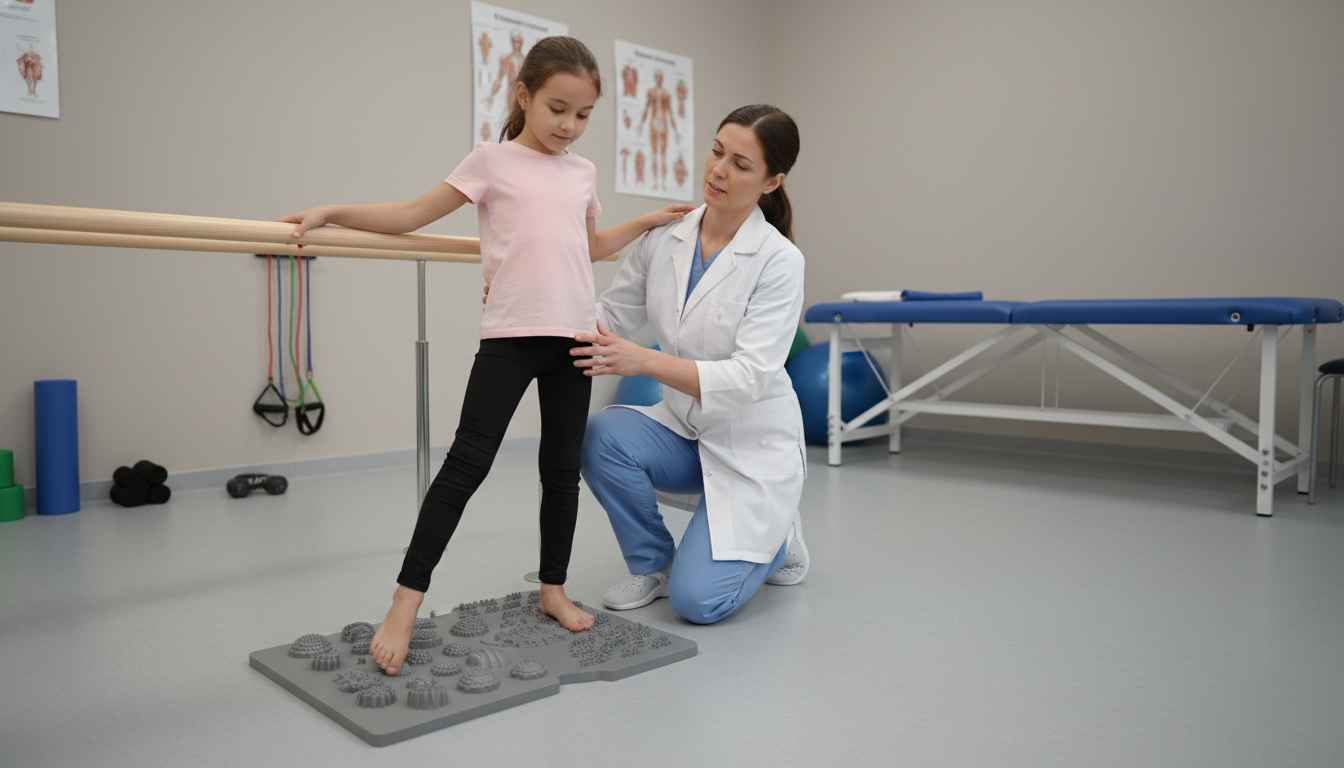
This study suggests that cutaneous mechanoreceptor stimulation provided by rough surfaces plays a vital role in recalibrating ankle proprioception. For clinicians, this implies that equipment selection should go beyond mere instability. Integrating textured mats, rough-surface balance boards, or barefoot training on granular surfaces may provide the necessary afferent feedback to enhance sensorimotor integration in children with spastic CP.
By simply altering the surface texture, therapists may be able to target the sensory limb of the sensorimotor loop more effectively, leading to better long-term functional outcomes.
References
Bezgin, S., Akkaya, K. U., Çiçek, İ., Akbaş, Y., & Elbasan, B. (2026). Effects of balance training on different surfaces on ankle proprioception and functional balance in children with spastic cerebral palsy: a single-blind randomized controlled trial. BMC Pediatrics.