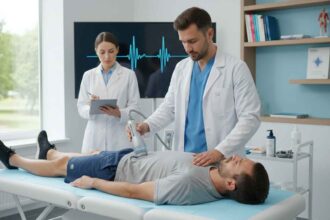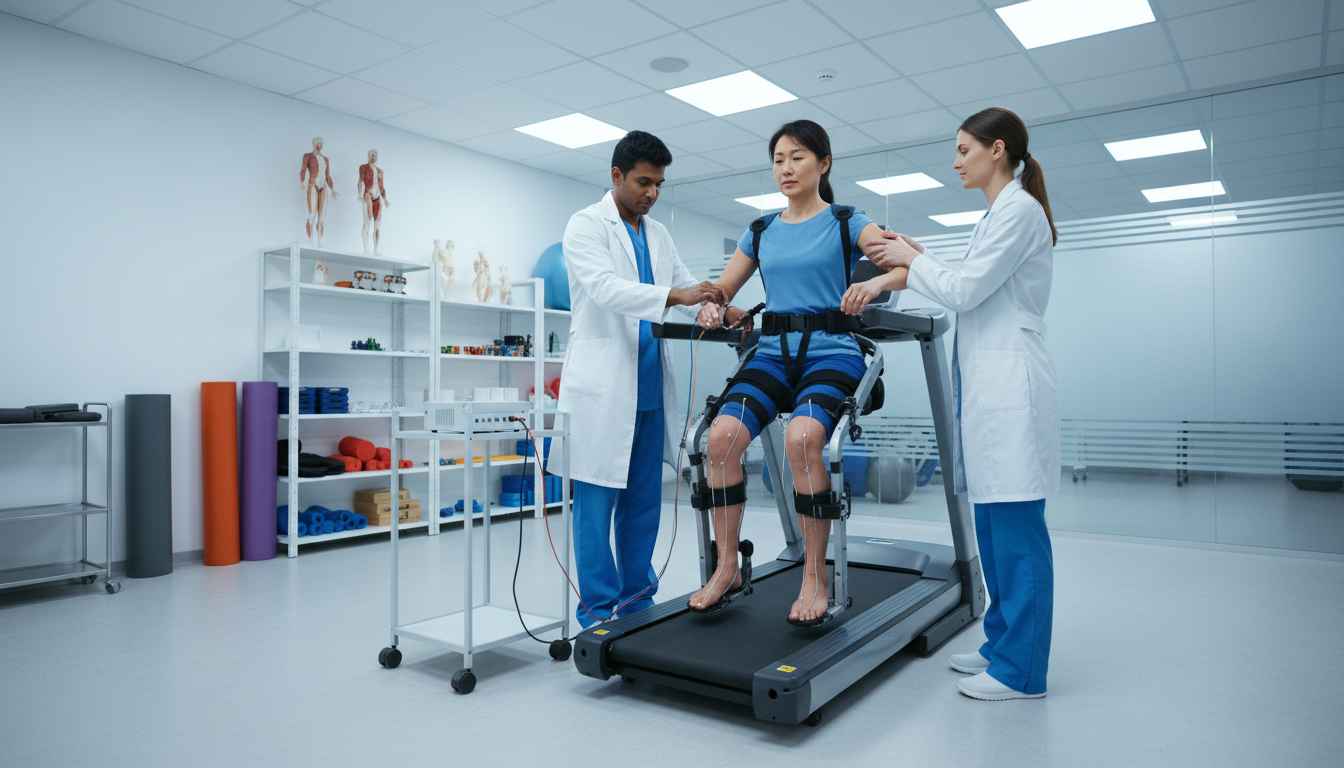
Stroke survivors frequently face persistent challenges with residual motor dysfunction, particularly in the lower limbs. For physiotherapy professionals, the quest to maximize functional outcomes often involves identifying synergistic therapies that can bridge the gap between peripheral mechanical training and central nervous system reorganization. A recent Randomized Controlled Trial (RCT), published in the Journal of Neuroengineering and Rehabilitation in December 2025, investigates a promising multimodal approach: combining Robot-Assisted Gait Training (RAGT) with Electroacupuncture (EA).
Establishing a Closed-Loop Regulatory System
The premise of this study, led by Huang et al., is rooted in the concept of a “closed-loop regulatory system.” Standard rehabilitation often focuses on peripheral inputs to stimulate motor recovery. However, by integrating direct interventions targeting the cerebral cortex (or subcortical structures) with indirect approaches like RAGT, clinicians may trigger a more robust reorganization of the central nervous system. The study aimed to determine if adding EA to RAGT could generate synergistic effects superior to RAGT alone.
Study Design and Clinical Interventions
This single-center, single-masked RCT involved 45 participants randomized into two groups: an intervention group receiving EA combined with RAGT (n=22) and a control group receiving RAGT alone (n=23). The intervention was intensive, consisting of daily 30-minute sessions, five days a week for three weeks.
To measure efficacy, the researchers utilized a comprehensive battery of assessments, including the Fugl-Meyer Lower Extremity (FMA-LE) assessment, the Functional Ambulation Category (FAC) scale, and the Berg Balance Scale (BBS). Crucially, the study also employed electroencephalogram (EEG) technology to observe changes in brain network characteristics.
Outcomes: Motor Function vs. Neuroplasticity
Clinically, the results were encouraging for both modalities. After the three-week intervention period, participants in both the combined group and the RAGT-only group demonstrated significant improvements in FMA-LE, FAC, and BBS scores compared to baseline. This reaffirms the efficacy of RAGT as a standalone tool for improving gait and balance.
However, the differentiation appeared in the neurological data. The group receiving the combined EA and RAGT therapy exhibited distinct neuroplastic changes that were not observed in the control group. Specifically, the EEG data revealed a reduction in the brain symmetry index within the alpha frequency band. Additionally, there was enhanced coherence between the CZ electrode and the FCZ, FC2, and C1 electrodes.
Optimizing Brain Functional Networks
The study highlights that the combined therapy may possess a specific advantage in reversing the pathological frequency spectrum imbalance often seen post-stroke. In the theta frequency band, the combined group showed a shortened average path length and improved global efficiency. These findings suggest that the addition of electroacupuncture helps optimize the topological properties of brain functional networks, effectively enhancing functional connections between sensorimotor-related brain regions.
For physiotherapists, this suggests that while mechanical training improves motor output, the addition of electroacupuncture may facilitate the underlying neural reorganization required for sustained recovery.
References
Huang, H., Su, X., Zhang, Y., Liu, Z., Xia, K., Xu, H., Zheng, B., Niu, X., Chen, S., Zhang, Y., Zhou, M., Zhong, Y., & Chen, J. (2025). Effect of robot-assisted gait training combined with electroacupuncture on lower limb motor function and brain network characteristics in stroke: an EEG study. Journal of Neuroengineering and Rehabilitation.
https://pubmed.ncbi.nlm.nih.gov/41430331/