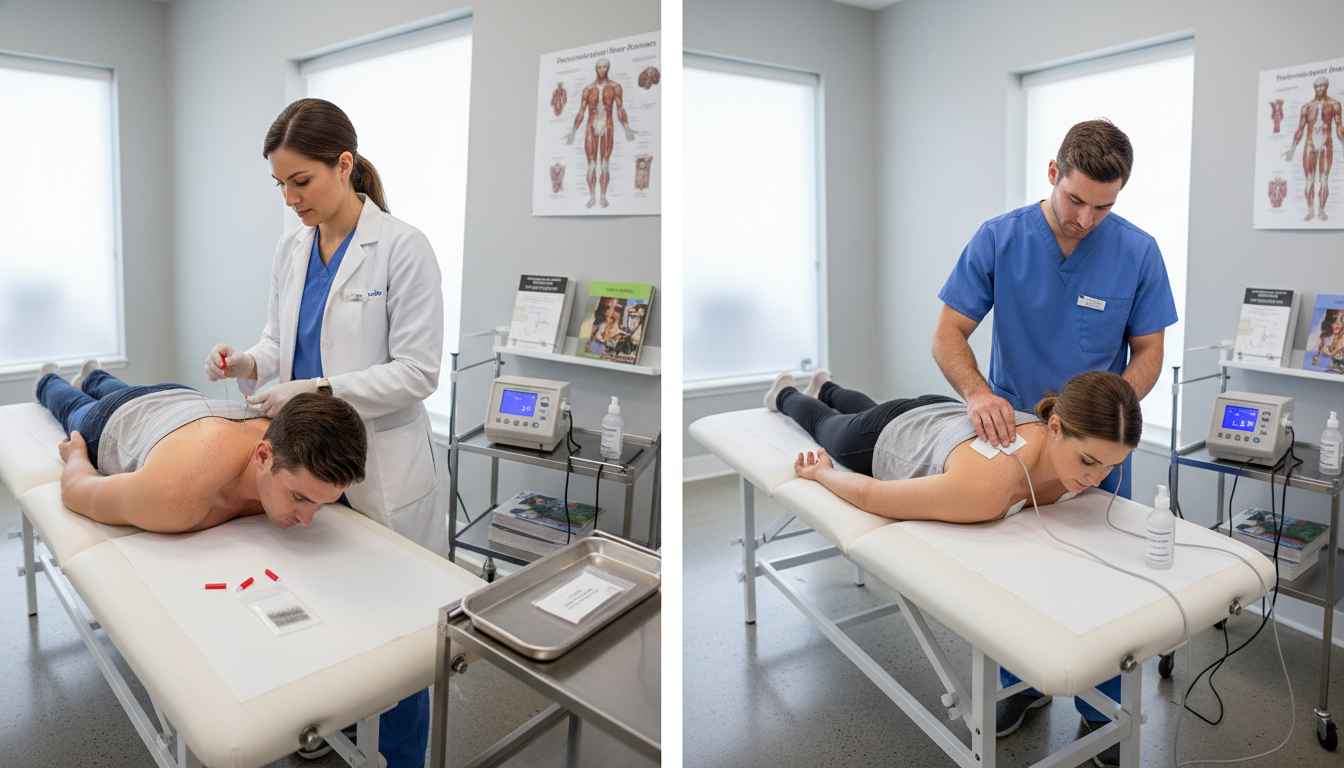
Neck pain remains one of the most persistent musculoskeletal complaints encountered in physiotherapy clinics, with myofascial trigger points (MTrPs) in the upper trapezius often identified as the primary source of dysfunction. As clinicians, we are constantly weighing the efficacy of invasive versus non-invasive modalities. A recent Randomized Controlled Trial (RCT) published in Acupuncture in Medicine (Feb 2026) offers compelling data comparing two distinct interventions: Dry Needling (DN) and Magnesium Sulfate (MgSO4) Iontophoresis.
The Clinical Challenge of Cervical Myofascial Pain
Upper trapezius active trigger points contribute significantly to pain intensity, reduced pressure pain thresholds (PPT), and altered muscle activation patterns. While manual stretching is a standard component of care, research consistently suggests that stretching alone may be insufficient for resolving stubborn MTrPs. The study by Abu El Kasem et al. aimed to determine whether the mechanical disruption of trigger points via dry needling yields better outcomes than the transdermal delivery of magnesium sulfate, a muscle relaxant, via iontophoresis.
Study Methodology: Comparing Interventions
The researchers recruited sixty subjects suffering from neck pain and active upper trapezius MTrPs. Participants were randomly assigned to one of three groups for a treatment duration of four weeks (twice weekly):
- Group A (Dry Needling): Received DN plus cervical muscle stretching.
- Group B (Iontophoresis): Received MgSO4 iontophoresis plus cervical muscle stretching.
- Group C (Control): Received only cervical muscle stretching.
Outcomes were measured using the Pressure Pain Threshold (PPT), the Arabic Neck Disability Index (ANDI), the Visual Analogue Scale (VAS) for pain intensity, and electromyography to assess cervical muscle amplitude (RMS).
Results: Mechanical Disruption vs. Chemical Relaxation
Post-treatment analysis revealed statistically significant improvements in both experimental groups compared to the control group. This reinforces the clinical consensus that stretching alone is often inferior to multimodal approaches.
However, the direct comparison between Dry Needling and Iontophoresis provided the most actionable insight. While MgSO4 iontophoresis did improve symptoms, Dry Needling demonstrated superior efficacy across all measured variables.
The statistical differences were robust:
- Pain Intensity (VAS): DN showed a mean difference of -2.0 compared to iontophoresis (p < 0.01).
- Function (ANDI): DN resulted in greater reduction in disability scores (p = 0.004).
- Muscle Physiology (RMS & PPT): DN led to better normalization of muscle amplitude and higher pressure pain thresholds (p < 0.001).
Implications for Physiotherapy Practice
For the orthopaedic manual therapist, these findings validate the use of dry needling as a primary intervention for upper trapezius MTrPs. The mechanical effect of the needle likely provides a more potent reset of the neuromuscular junction than the physiological relaxation attempted through magnesium iontophoresis.
However, the study also highlights that MgSO4 iontophoresis is effective. For patients who are needle-phobic or have contraindications to invasive procedures, iontophoresis remains a valid, evidence-based alternative to standard stretching protocols.
References
Abu El Kasem, S. T., Moustafa, E. B., & Abd El-Azeim, A. S. (2026). Dry needling versus magnesium sulfate iontophoresis of active trigger points of the axioscapular muscle in neck pain: a single blind randomized controlled trial. Acupuncture in Medicine.
https://pubmed.ncbi.nlm.nih.gov/41549044/