Harnessing Neuroplasticity for Enhanced Motor Control
In modern physiotherapy and orthopaedic rehabilitation, the quest to optimize motor learning and neuroplasticity is ongoing. Modalities such as transcranial direct current stimulation (tDCS) and progressive resistance training are well-documented for their individual capacities to modulate cortical excitability. However, the exact synergistic effects of combining these two interventions have remained somewhat elusive. A compelling randomized controlled trial by Yue et al. (2026) published in Behavioural Brain Research investigated whether coupling non-invasive brain stimulation with physical loading could yield superior motor learning outcomes compared to either intervention applied in isolation.
The Methodology Behind the Synergy
To understand the clinical value of this approach, researchers designed a rigorous randomized controlled trial involving 52 healthy young adult males. The participants were divided into four distinct groups: tDCS combined with resistance training, sham tDCS combined with resistance training, tDCS alone, and a control group receiving sham tDCS. The interventions were administered twice a week over a six-week period. During the sessions, active tDCS was applied over the primary motor cortex at an intensity of 2 mA for 20 minutes. Lower-limb resistance training was integrated directly into the stimulation timeline. To measure the efficacy of the interventions, motor learning was quantitatively assessed utilizing the serial reaction time task (SRTT) at four strategic intervals: baseline, three weeks, six weeks, and one week post-intervention.
Crucial Timelines for Neuromuscular Adaptation
The findings from the SRTT assessments revealed a fascinating timeline for neuromuscular adaptation. By the three-week mark, both groups engaging in combined therapies exhibited faster overall reaction times across multiple blocks compared to the tDCS-alone and control groups. However, the most clinically significant finding emerged at the six-week threshold. At this point, the group receiving both active tDCS and resistance training demonstrated profound, statistically significant improvements in sequence-specific motor learning compared to both the sham tDCS with resistance training group and the control group. Interestingly, neither tDCS alone nor resistance training with sham stimulation produced sequence-specific learning improvements that outperformed the control group at any time point. This strongly suggests that the concurrent application of cortical stimulation and mechanical loading creates a unique physiological environment that accelerates complex motor pathway encoding.
Clinical Implications for Physiotherapy Practice
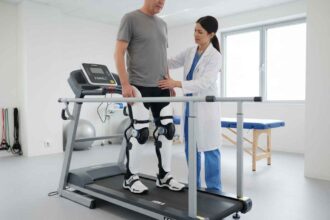
For orthopaedic and sports physiotherapists, this research underscores the potential of multimodal rehabilitation strategies. The synergistic application of tDCS and resistance training can serve as a powerful catalyst for motor learning, potentially accelerating functional recovery phases for patients regaining lower-limb control. However, a crucial caveat emerged during the post-intervention follow-up: the dramatic improvements observed at six weeks diminished after training ceased. By the one-week post-intervention assessment, the combined group no longer showed statistical superiority. This transient nature highlights a vital clinical principle regarding neuroplasticity: maintenance is key. Physiotherapists integrating neuromodulation into their resistance training protocols must design ongoing maintenance phases or transition strategies to ensure that the newly acquired motor efficiencies are permanently consolidated into the patient’s movement repertoire.
References
Yue, T., Zhang, J., Zuo, Z., & Qi, F. (2026). Six weeks of transcranial direct current stimulation combined with resistance training improves motor learning in healthy young adults. Behavioural brain research. https://pubmed.ncbi.nlm.nih.gov/41765234/