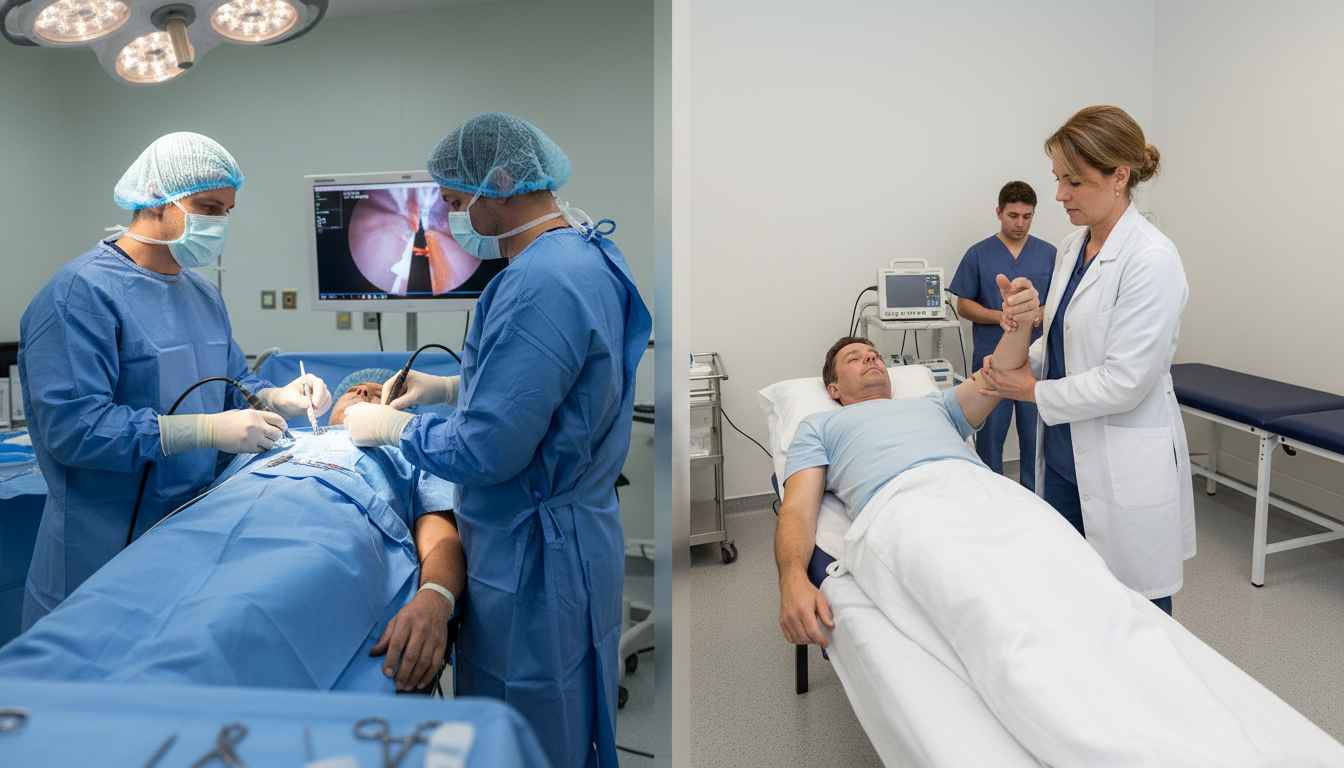
Adhesive capsulitis, commonly known as frozen shoulder, remains a challenging condition for physiotherapists and orthopaedic surgeons alike. While conservative management—including physical therapy and corticosteroid injections—is the first line of defense, refractory cases often require surgical intervention. The two primary procedural options, Arthroscopic Capsular Release (ACR) and Manipulation Under Anaesthesia (MUA), have long been debated regarding their efficacy and safety profile. A 2022 prospective randomised study published in International Orthopaedics by Sundararajan et al. provides critical Level-I evidence comparing these two interventions, specifically looking at outcomes, complications, and cost-effectiveness.
Comparative Efficacy in Adhesive Capsulitis
The study randomized 85 patients presenting with frozen shoulder into two distinct groups: ACR (n=44) and MUA (n=41). Patients with confounding factors such as arthritis, full-thickness cuff tears, or prior shoulder trauma were excluded to ensure a homogeneous sample. The researchers utilised a robust set of metrics, including Visual Analogue Scale (VAS) for pain, Range of Motion (ROM), and functional scores (UCLA, CONSTANT, and EuroQol-5D) measured both pre-operatively and post-operatively.
The results at the 24-week follow-up marked a significant win for both procedures. Patients in both the ACR and MUA groups demonstrated significant improvement in pain reduction, ROM restoration, and functional scores (P < 0.001). Crucially, there was no statistically significant difference between the two groups regarding these primary outcomes. This suggests that from a purely functional standpoint, both techniques are highly effective in resolving the mechanical restrictions of adhesive capsulitis.
Complications and MRI Findings
For the rehabilitation professional, understanding the potential tissue trauma associated with these procedures is vital for post-operative management. The study included a unique protocol where MRI screening was performed three weeks post-operatively to assess iatrogenic complications. The imaging revealed distinct pathology profiles for each group:
- MUA Group: The most common complication was labral tears.
- ACR Group: The most common complication was bone bruising.
Interestingly, the study noted a specific variance in the diabetic population. Diabetic patients undergoing ACR showed less improvement in abduction and external rotation compared to non-diabetic patients, a nuance that clinicians should consider when counseling diabetic patients on surgical options.
Cost-Utility Analysis and Clinical Implications
Perhaps the most differentiating factor in this study was the cost-effectiveness analysis using Quality-Adjusted Life Years (QALY). In an era of value-based healthcare, the economic burden of treatment protocols is under increasing scrutiny. The study found that MUA was significantly more cost-effective than ACR. The cost per QALY gained was 424 USD for MUA, compared to 896 USD for ACR.
While ACR allows for a controlled, visual release of the capsule, the study concludes that MUA remains an attractive option due to its simplicity, equivalent clinical outcomes, and superior cost-effectiveness. For physiotherapists, this reinforces the validity of MUA as a potent intervention for refractory frozen shoulder, provided that rehabilitation protocols respect the potential for labral pathology associated with the manipulation.
References
Sundararajan, S. R., Dsouza, T., Rajagopalakrishnan, R., Bt, P., Arumugam, P., & Rajasekaran, S. (2022). Arthroscopic capsular release versus manipulation under anaesthesia for treating frozen shoulder – a prospective randomised study. International Orthopaedics, 46(11), 2547–2554.