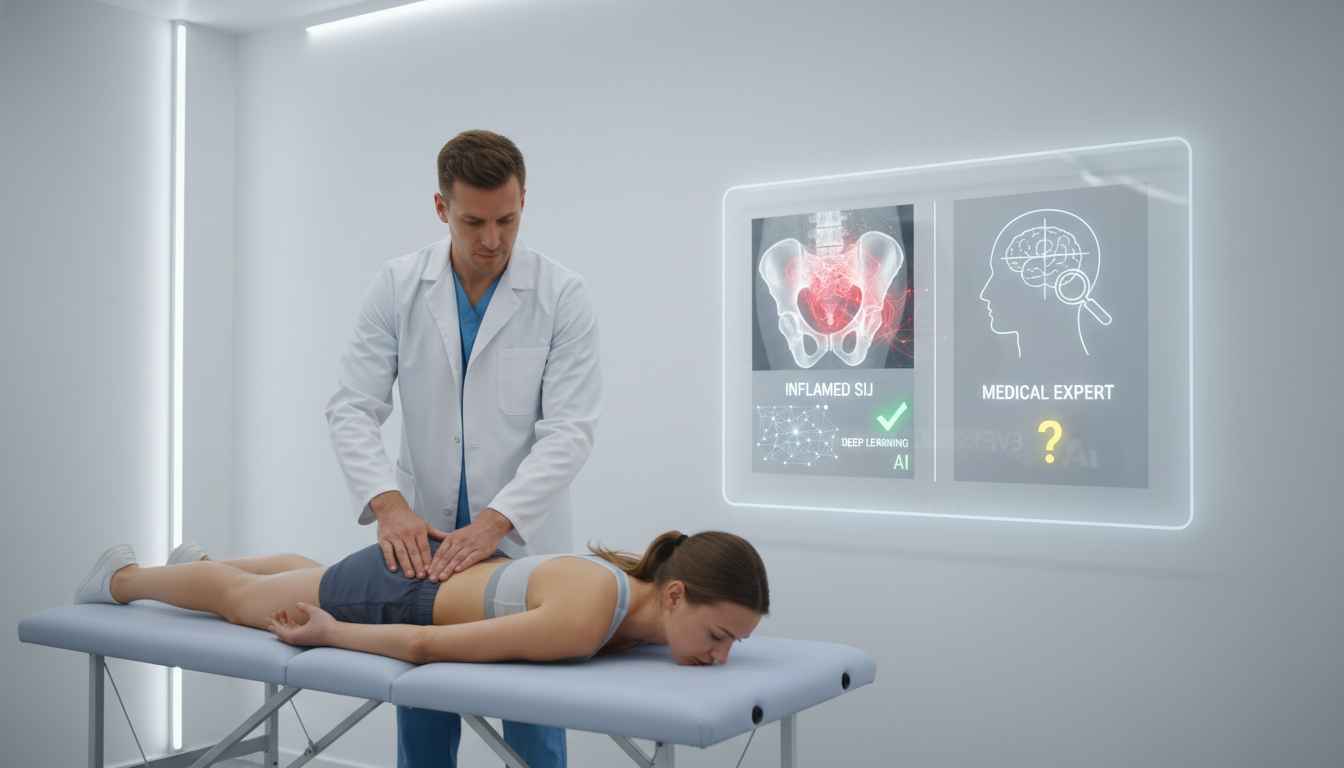
The diagnosis of axial spondyloarthritis (axSpA) remains a significant clinical challenge, often characterized by substantial delays between symptom onset and confirmed diagnosis. Magnetic Resonance Imaging (MRI) of the sacroiliac joints (SIJ) is the gold standard for detecting early inflammation, yet the interpretation of these images can vary significantly between radiologists, leading to inconsistencies in patient management. A pivotal new study published in the Annals of the Rheumatic Diseases (January 2025) investigates whether artificial intelligence can bridge this gap by validating a deep-learning algorithm against human expert consensus.
The Need for Automated MRI Analysis in Rheumatology
For physiotherapists managing patients with inflammatory back pain, the reliance on accurate imaging reports is paramount. The interpretation of SIJ inflammation according to the Assessment of SpondyloArthritis International Society (ASAS) definitions requires high expertise. Variability in image quality across different scanners and the subjective nature of human assessment often create bottlenecks.
In this large-scale external validation study, researchers aimed to assess the performance of a pre-trained deep-learning algorithm. The goal was to see if a machine could accurately identify bone marrow edema and inflammation in the sacroiliac joints of patients with both non-radiographic and radiographic axSpA.
Study Methodology and External Validation
The robustness of this study lies in its data source. The researchers pooled baseline MRI scans from two major prospective randomized controlled trials: RAPID-axSpA and C-OPTIMISE. This created a substantial validation cohort of 731 patients (mean age 34.2 years). Importantly, the study reflected real-world variability by including scans from over 30 different scanner models produced by five different manufacturers across more than 100 clinical sites.
The algorithmic assessments were compared against a rigorous reference standard: central evaluation by two expert readers (with an adjudicator for disagreements). The experts were blinded to the AI results, and the AI was blinded to clinical data.
Performance Metrics: Sensitivity and Specificity
The results offer a promising, though nuanced, look at the future of automated diagnostics. Among the 731 patients, experts identified inflammation in roughly 60% of cases. When compared to these human experts, the deep-learning algorithm demonstrated:
- Specificity of 81% (95% CI 78% to 84%): The algorithm was quite effective at correctly identifying healthy joints, meaning a low rate of false positives.
- Sensitivity of 70% (95% CI 66% to 73%): The algorithm identified the majority of positive cases but missed approximately 30% of inflammation that experts caught.
- Positive Predictive Value (PPV) of 84%: When the AI flagged inflammation, it was highly likely to be correct.
The absolute agreement between the machine and the experts was 74%, with a Cohen’s kappa of 0.49, suggesting moderate agreement. While not yet a replacement for a specialist radiologist, the high specificity and PPV suggest the tool could be valuable for confirming diagnoses and standardizing reading workflows.
Implications for Physiotherapy Practice
For the physiotherapy community, the integration of AI into the diagnostic pathway of axSpA suggests a future with faster, more standardized reporting. While the sensitivity of 70% indicates that clinical judgement and expert human review remain essential to catch subtle cases, the algorithm’s ability to process images from diverse scanners makes it a potentially powerful triage tool. As AI tools evolve, physiotherapists can expect more consistent referral outcomes, aiding in the early identification and management of spondyloarthritis.
References
Nicolaes, J., Tselenti, E., Aouad, T., López-Medina, C., Feydy, A., Talbot, H., Hoepken, B., de Peyrecave, N., & Dougados, M. (2025). Performance analysis of a deep-learning algorithm to detect the presence of inflammation in MRI of sacroiliac joints in patients with axial spondyloarthritis. Annals of the rheumatic diseases. https://pubmed.ncbi.nlm.nih.gov/39874235/