Essential tremor (ET) represents the most common movement disorder encountered in clinical practice, often leading to significant functional impairment in the upper extremities. While pharmacological interventions and deep brain stimulation have been the mainstays of treatment, they often carry risks of systemic side effects or require invasive surgical procedures. A pivotal new Randomized Clinical Trial (RCT) published in JAMA Neurology by Ondo et al. (2025) investigates a non-invasive alternative: an Artificial Intelligence (AI)-driven Transcutaneous Peripheral Nerve Stimulation (TPNS) device.
Targeting the Peripheral Nervous System
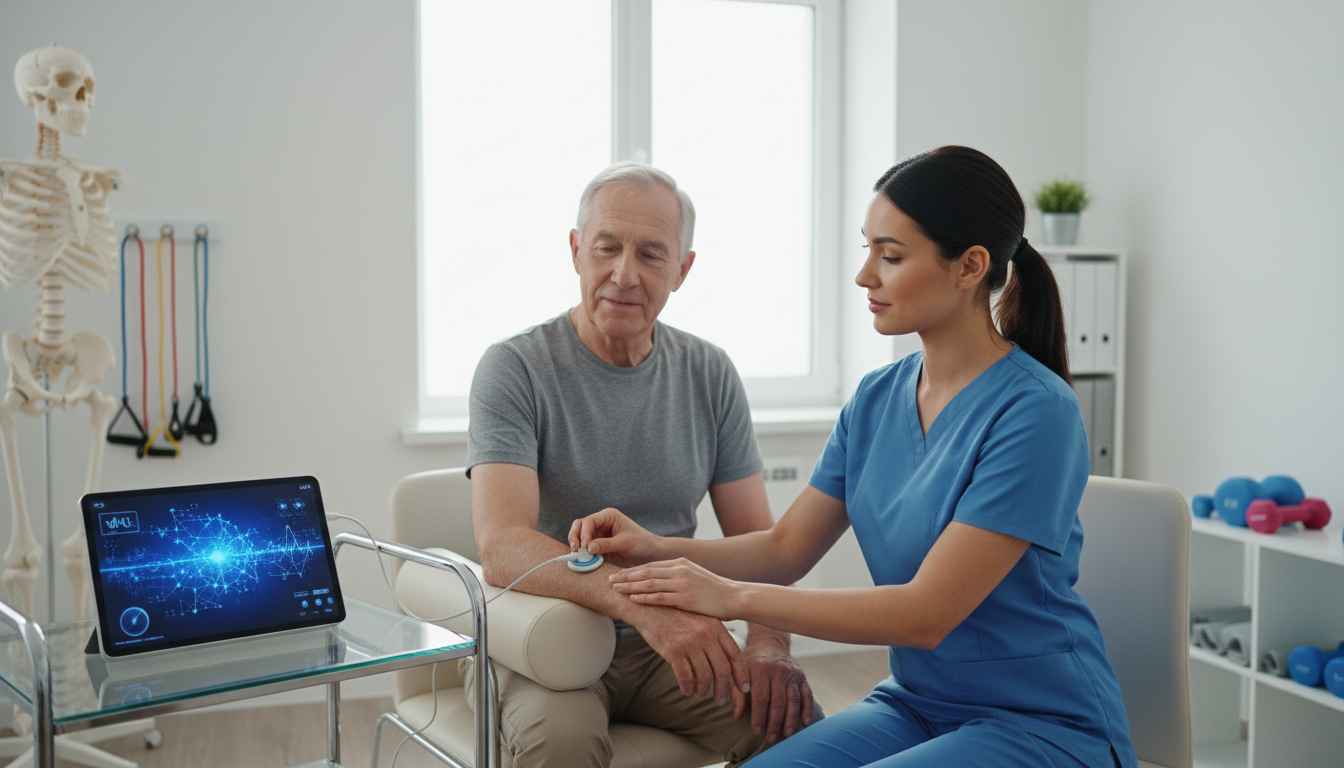
The premise of TPNS lies in its ability to modulate the central tremor-generating network via peripheral pathways. The device utilized in this multi-center study is a wearable neuromodulation unit designed to stimulate the radial, median, and ulnar nerves at the wrist. Unlike static TENS units often used in orthopedic rehabilitation, this device employs AI to continuously adjust stimulation settings in real-time based on the patient’s tremor characteristics.
The study randomized 125 adults with a clinical diagnosis of ET across 12 outpatient neurology clinics in the United States and China. Participants, who had a mean tremor duration of 11.4 years, were assigned to either an active TPNS group or a sham stimulation group. They were instructed to wear the device during waking hours for a duration of 90 days. This design is particularly relevant to physiotherapy professionals, as it assesses the efficacy of a functional aid in a real-world, home-based setting rather than a controlled clinical environment alone.
Significant Improvements in Activities of Daily Living
For rehabilitation specialists, the primary outcome measure of this study is highly pertinent: the modified Activities of Daily Living (mADL) subscale of the Essential Tremor Rating Assessment Scale (TETRAS). Improvements in ADLs directly correlate to patient quality of life and functional independence.
At the 90-day mark, the results showed a statistically significant superiority of the active TPNS device over the sham device. The TPNS group demonstrated a reduction in the mADL score by 6.9 points (95% CI, 5.4-8.4), compared to only a 2.7-point reduction in the sham group (P < .001). This suggests that peripheral modulation can translate into tangible functional gains, such as improved ability to eat, drink, and perform fine motor tasks, which are often the primary goals in occupational and physical therapy plans for ET patients.
Safety Profile and Adverse Events
As with any modality involving cutaneous stimulation, skin integrity remains a concern. The study reported that skin irritation was the most common device-related adverse event, occurring in 33.7% of the active TPNS group compared to 4.8% in the sham group. Other adverse events were rare but included singular instances of nausea, arthralgia, and worsening of existing thumb arthritis. For physiotherapists recommending or managing such devices, this highlights the necessity of monitoring skin health and electrode placement sites during follow-up visits.
Clinical Relevance for Rehabilitation
The findings by Ondo et al. suggest that AI-driven TPNS is an effective, non-invasive treatment option for upper limb tremor. For the orthopaedic and neurological physiotherapist, this technology represents a potential adjunct to exercise therapy and functional training. By reducing tremor amplitude via peripheral nerve stimulation, patients may achieve a window of improved motor control, potentially facilitating better engagement in rehabilitation exercises and daily tasks.
References
Ondo, W. G., Lv, W., Zhu, X., Hu, Y., Isaacson, S. H., Yuan, Y., Espay, A. J., Kreitzman, D., Kuo, S. H., Brillman, S., Shill, H. A., Lyons, K. E., Yang, Z., Zhao, Q., Zhang, Z., & Pahwa, R. (2025). Transcutaneous Peripheral Nerve Stimulation for Essential Tremor: A Randomized Clinical Trial. JAMA Neurology. Advance online publication.