Percutaneous transforaminal endoscopic discectomy (PTED) has firmly established itself as a preferred minimally invasive intervention for lumbar disc herniation (LDH). Its ability to minimize tissue trauma and accelerate postoperative recovery makes it highly relevant to orthopaedic rehabilitation professionals. However, the procedure, typically performed under local anesthesia (LA), presents challenges regarding intraoperative pain management, particularly during foraminoplasty and annulus fibrosus manipulation. A randomized controlled trial (RCT) published in February 2026 in Annali italiani di chirurgia investigates the clinical utility of the ultrasound-guided erector spinae plane block (ESPB) as a potential solution to enhance patient comfort and hemodynamic stability.
Methodology: ESPB Versus Local Anesthesia
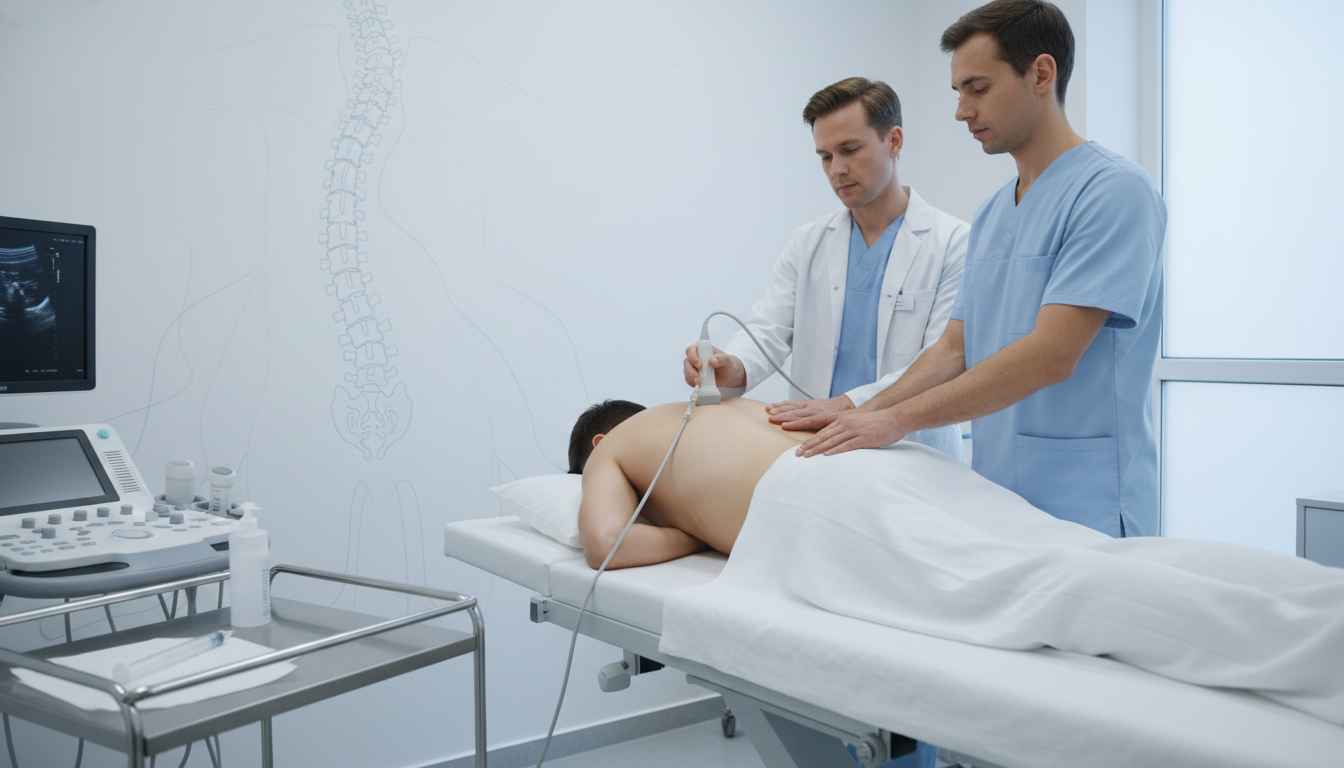
The study, conducted by Zheng et al., was designed as an exploratory RCT involving 60 patients diagnosed with lumbar disc herniation. The participants were randomized into two equal groups (n=30) to undergo PTED. One group received standard local anesthesia (LA), while the experimental group received an ultrasound-guided erector spinae plane block (ESPB). The researchers aimed to evaluate not only the feasibility of the block but also its impact on intraoperative physiology and patient-reported pain measures.
Outcomes were rigorously measured at four distinct time points: prior to anesthesia (T0), during foraminoplasty (T1), during annulus fibrosus manipulation (T2), and at the surgery’s conclusion (T3). Key metrics included heart rate (HR), mean arterial pressure (MAP), and Visual Analogue Scale (VAS) scores for pain. Long-term functional outcomes were tracked using the Oswestry Disability Index (ODI) at 3 and 6 months postoperatively.
Outcomes: Hemodynamic Stability and Analgesia
The results highlighted distinct advantages for the ESPB protocol regarding intraoperative management. Patients in the ESPB group demonstrated significantly greater hemodynamic stability compared to the LA group. Specifically, HR and MAP fluctuations were less pronounced, suggesting a reduced physiological stress response to the surgical trauma.
Furthermore, the analgesic efficacy of the block was evident. VAS scores were significantly lower in the ESPB group from the onset of foraminoplasty (T1) through to the end of the procedure (T3) (p < 0.05). This suggests that the erector spinae plane block effectively mitigates the sharp nociceptive input associated with bone and disc manipulation in endoscopic procedures.
Interestingly, while the immediate surgical experience was improved, surgical parameters such as operative time, blood loss, and length of hospital stay showed no significant differences between the two groups. Similarly, while both groups improved significantly over time regarding functional disability (ODI), the method of anesthesia did not statistically alter the long-term rehabilitation trajectory at the 3 or 6-month marks.
Implications for Physiotherapy and Rehabilitation
For the physiotherapist, understanding the nuances of intraoperative anesthesia is vital for patient education and managing postoperative expectations. While this study suggests that ESPB does not necessarily accelerate the timeline for tissue healing or functional milestones compared to local anesthesia, the reduction in intraoperative pain and hemodynamic stress is clinically valuable. A smoother intraoperative experience may reduce central sensitization risks and improve patient satisfaction with the surgical intervention.
As PTED continues to evolve, the integration of advanced regional anesthesia techniques like ESPB appears to be a feasible and beneficial enhancement for patient comfort. Physiotherapists should remain aware of these surgical trends, as they contribute to the holistic narrative of patient care from the operating table to the rehabilitation clinic.
References
Zheng, X., Jiang, J., Yan, Y., Chen, Q., Zheng, G., Wang, B., Huang, B., Chen, W., & Su, Q. (2026). Clinical Utility of Ultrasound-Guided Erector Spinae Plane Block in Percutaneous Transforaminal Endoscopic Discectomy. Annali italiani di chirurgia. https://pubmed.ncbi.nlm.nih.gov/41681092/