Stroke remains a predominant cause of long-term disability globally, with early mobilization being a critical factor in determining long-term prognosis. For physiotherapists working in acute and sub-acute settings, the challenge often lies in delivering high-repetition, high-intensity therapy to patients with severe motor deficits without inducing therapist fatigue or compromising patient safety. A recent Randomized Controlled Trial (RCT) published in the Journal of Visualized Experiments (JoVE) by Yao et al. (2025) offers compelling evidence regarding the integration of bedside lower extremity rehabilitation robots into early stroke care.
The Shift Toward Automated Early Mobilization
In the acute phase of recovery, patients presenting with hemiplegia and significant muscle weakness (Grade ≤ 2) require intensive intervention to stimulate neuroplasticity. Conventional manual therapy (CMT) is the gold standard but is labor-intensive and difficult to standardize. The study titled “Application of Bedside Lower Extremity Rehabilitation Robots in Stroke Rehabilitation” sought to evaluate not just the clinical efficacy, but also the patient experience of robot-assisted therapy (RAT) compared to traditional manual approaches.
The researchers recruited forty inpatients with first-onset stroke and lower limb muscle strength of Grade ≤ 2. Using a rigorous randomized design (1:1 allocation), patients were divided into a robot-assisted group and a conventional manual therapy group. This study is particularly relevant for clinicians as it utilized a two-stage intervention design, mimicking real-world progression where the robot-assisted group received a combination of robotic training and artificial therapy in later stages of recovery.
Analyzing Efficacy: FMA-LE and Barthel Index Scores
The primary outcomes measured included the Fugl-Meyer Assessment for lower extremities (FMA-LE), the Modified Ashworth Scale (MAS), and the Modified Barthel Index (MBI). The results indicated that robot-assisted therapy is far more than a passive novelty. While early motor gains were similar between the two groups, the robot-assisted group demonstrated greater functional improvements in the later stages of rehabilitation.
This suggests that the consistency and precision provided by bedside robots may lay a stronger foundation for complex functional tasks as the patient progresses. For the physiotherapist, this indicates that robotic aids can successfully offload the heavy lifting required in early-stage passive and active-assistive movements without sacrificing clinical outcomes.
Patient Comfort as a Clinical Metric
Perhaps the most distinguishing finding of this RCT was related to the General Comfort Questionnaire (GCQ). The study found that patients in the robot-assisted group reported superior comfort scores compared to those receiving manual therapy. In acute stroke care, patient comfort is often correlated with compliance and reduced anxiety.
Manual manipulation, while effective, can vary significantly based on the therapist’s technique and fatigue levels. Bedside robots provide a smooth, consistent trajectory of movement that may feel safer and more predictable to a patient with severe hemiplegia. By enhancing the patient experience, clinicians may see improved adherence to therapy regimens and a more positive psychological outlook toward recovery.
Integrating Robotics into Practice
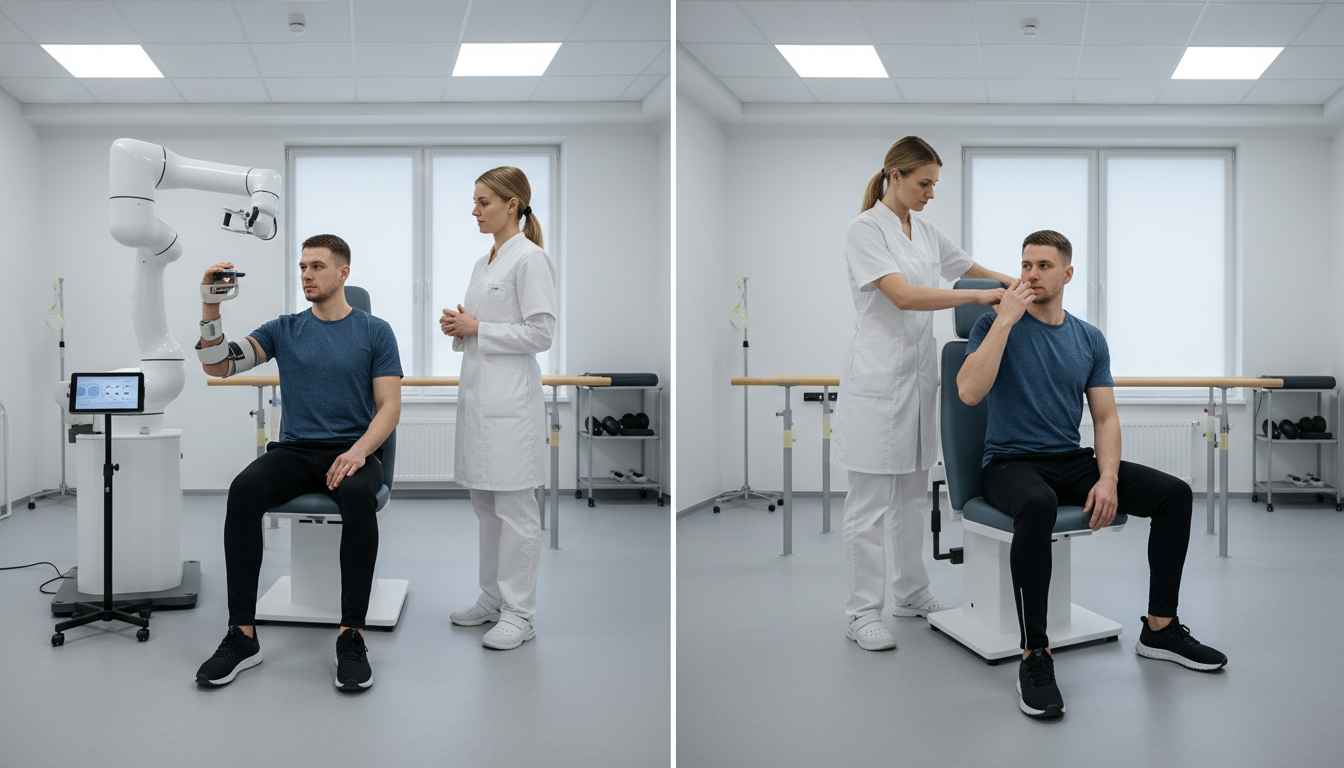
The study concludes that integrating bedside rehabilitation robots is feasible, safe, and clinically effective. For orthopedic and neurological rehabilitation specialists, this evidence supports a hybrid model of care. By utilizing robotics for repetitive, high-intensity early mobilization, therapists can focus their manual skills on proprioceptive facilitation and functional task training, ultimately optimizing the rehabilitation pathway for stroke survivors.
References
Yao, B., Liu, Y., Yao, Z., Chen, J., Qi, B., & Chen, Z. (2025). Application of bedside lower extremity rehabilitation robots in stroke rehabilitation: A randomized controlled trial. Journal of Visualized Experiments. https://pubmed.ncbi.nlm.nih.gov/41396879/