Post-stroke spasticity (PSS) remains one of the most persistent challenges in neurorehabilitation. Clinicians understand that PSS is not merely a symptom of central neural hyperexcitability; it also involves maladaptive architectural changes within the muscle tissue itself, such as shortening fascicle length and altered pennation angles. A recent Randomized Controlled Trial (RCT) published in NeuroRehabilitation (2026) investigates a dual-mechanism approach, suggesting that targeting both the muscle periphery and the central nervous system yields superior outcomes.
Targeting Neural and Structural Mechanisms
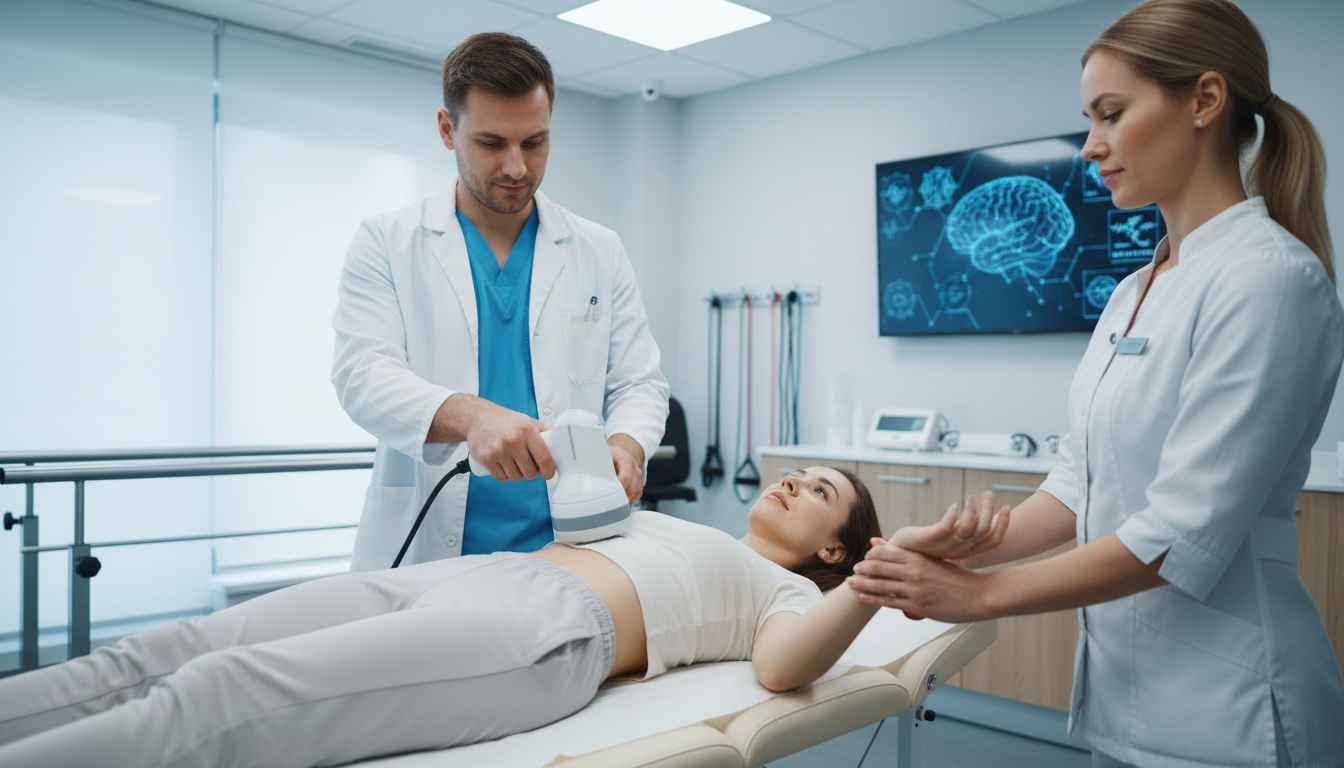
The study, conducted by Afzal et al., sought to evaluate the combined efficacy of Extracorporeal Shockwave Therapy (ESWT) and a Neuroplasticity-Based Training Protocol (NBTP). The premise is clinically sound: ESWT addresses the rheological and structural properties of the spastic muscle, potentially creating a wider therapeutic window for neuroplastic training to facilitate adaptive neural reorganization.
Fifty-four patients with lower limb spasticity were randomized into two groups. The experimental group received active ESWT combined with NBTP, while the control group received sham ESWT with the same training protocol. The ESWT parameters were specific: 1,500 shocks at 5 Hz with an energy flux density of 0.10 mJ/mm², targeting the gastrocnemius muscle for six weekly sessions. Simultaneously, participants underwent a 12-week NBTP regimen, which included mirror therapy, resistance and aerobic training, motor imagery, and task-specific activities.
Functional and Ultrasonographic Outcomes
Outcomes were measured at baseline, week 6, and week 12, utilizing the Modified Ashworth Scale (MAS), Passive Range of Motion (PROM), and the Fugl-Meyer Assessment-Lower Extremity (FMA-LE). Uniquely, the researchers also employed ultrasonography to measure muscle thickness (MT), muscle fascicle length (MFL), and pennation angle (PA), providing objective data on structural remodeling.
By the 12th week, the results overwhelmingly favored the combinatorial approach. The group receiving active ESWT showed significantly greater reductions in spasticity (MAS) and improvements in motor function (FMA-LE) compared to the sham group. Furthermore, PROM significantly increased in the experimental group. On the structural level, ultrasonography revealed significant differences in pennation angle and muscle thickness, suggesting that the intervention successfully modified the intrinsic stiffness of the muscle.
Clinical Implications for Physiotherapists
This study highlights the importance of multimodal treatment plans. While neuroplasticity training remains the cornerstone of stroke rehabilitation,